Controlling fear
It’s taken many years to conquer my fear of flying. And what helped immensely was understanding the real root of that fear.
It was a control thing. Let’s face it, when you’re strapped in the back of long metal tube hurtling through the atmosphere six miles above the earth, you have very little control. You don’t even get to control your seatback and tray table much of the time. The math people will say, “You’re statistically much safer flying than driving.” But math doesn’t give me the feeling of control like a steering wheel does.

My real issue was wanting to be in control. Maybe that’s what’s behind your biggest fears, too.
Having control of things around us is not the problem. The problem is that we THINK we control things that we really don’t. Or we WANT to control things we really don’t.
There’s a better way. And it’s found in the verse we’ve been working on as a church. It’s King Solomon’s wisdom in Proverbs 3:5-6:
Trust in the Lord with all your heart, and don’t lean on your own understanding. In all your ways acknowledge him, and he will make your paths straight.
When we acknowledge God…when we realize that he really IS God, that he’s in complete control of his creation, then we can begin to loosen our death grip on the control wheel of our life. (Which is really like one of those kids’ steering wheels that you attach to their car seat. Because you and I can’t control our lives in a way that we like to think we can.)
This is where you cue the track for “Jesus Take the Wheel.” Because honestly, we can’t control:
- How our friends will act.
- Or how the economy will react.
- Or how the weather will cooperate.
- Or how our genetic makeup will affect our health.
- Or how our new neighbors will turn out.
- Or how our kids will behave on their first date.
- Or how our parents will decline with age.
- Or how the job market will be when we graduate.
But, when we acknowledge God as God, when we lean into him at every point along the way, THEN we can live each day moving along the path that he has for us. Confident in his control of his world. And that confidence helps remove our fear. And it reduces my need to try to control everything and everyone around me.

It sets us free to fly.
-Pastor Mark
Are you in danger of toppling over?
Life is often about extending our reach. Extending our influence, our relationships, our financial goals, our career ambitions, even our lifespan. But reaching can lead to toppling. Just ask anyone who’s tried to reach too far while up on a ladder! So here’s how to prevent toppling in life.
Your reach will be determined by your roots. If you think of your life as a tree, then realize that the branches (reach or impact) can’t go beyond what the roots can support. To impact others around you, or to extend your relationships, or your career requires greater reach…which requires greater roots. Otherwise, the tree will eventually topple over. Sometimes we refer to that toppling as burnout. Or moral failure. Or career-limiting-moves. Or incompetence. But all these share a common cause…a lack of rootedness.
So this year, as you consider the impact you’d like your life to have, give some thought to how you’re going to develop your roots. You may want to consider some of the classic practices of the Christian faith. Things like prayer, reflecting on Scripture, solitude, or fasting. You may want to revisit your calendar and add things like community, worship, and service. These and others practices all have the potential to drive our roots deeper into the person of Jesus Christ. And when we do that, we can reach further, influence greater, and bear much fruit in the coming year.
So then, just as you received Christ Jesus as Lord, continue to live your lives in him, rooted and built up in him, strengthened in the faith as you were taught, and overflowing with thankfulness. (Colossians 2:6-7, NIV, emphasis added)
What will you do this year to develop your roots?
-Pastor Mark
P.S. Did you come up with one word? Or one verse? (see last week’s post)
3 steps to make the next 51 weeks matter

You have 51 weeks left in front of you. How will you use those 51 weeks?
We’re one week into the New Year. Maybe you’ve made resolutions. Maybe you’ve already broken them! It doesn’t matter. What matters is what you do the rest of the year. Fifty-one more weeks. Here are three steps you can take now to make the most of the 51.
- Choose one word you want to focus on in the coming year. Words like generosity, gratitude, ambition, rest, friendships, reflection, creativity, forgiveness, learning, etc.
- Choose one verse from Scripture you can focus on in the coming year. Make it a verse that captures part of God’s truth, wisdom and power. g. some of the verses we’ve worked on for the Celebration Challenge.
- Choose to live your life under new management this year…specifically, the management of Jesus himself. For help in doing this, join in our new weekend series, “Under New Management.” (If you missed last week, catch the podcast here and check out the life-transforming Daniel Plan this Saturday at Noon.)
- Tell someone about your decisions. I know, that’s technically a fourth step. But it’s really just completing the first three. Hey, I majored in Bible, not math. 🙂
So forget last week. Focus on the upcoming week. One word. One verse. New Management. Then watch what God can do through you!
-Pastor Mark
P.S. My word for 2015 is “courage.” And my verse for 2015 is 1 Corinthians 16:13 (NIV) – Be on your guard; stand firm in the faith; be courageous; be strong.
The death of Santa

WARNING: Don’t read this aloud to your kids if they’re under the age of 12.
You won’t read much about this in the news feeds or on social media. But I want to talk for a moment about the death of Santa. Let me explain.
Christmas has become all about the gifts, and that’s connected (loosely) to the legend of Santa. As you likely know, Santa is a figure loosely based on “Saint Nicholas” a 3rd century Bishop (from Myra in modern day Turkey) who allegedly gave generous gifts to those in his community out of his own great riches. (for more info, click here)
Here’s the irony…the one who really started all the gift giving is God himself. In fact, you could even make a case that Jesus was the first “Santa” since the apostle Paul reminds us that, “when he ascended…he gave gifts to his people.” (Ephesians 4:8) He gave out of his own great riches. Think about it…hasn’t he given you the gift of forgiveness? Of freedom? Of hope? Of new life itself?
And yet none of this would have been possible without his sacrificial death on the cross. Before there was a traditional Christmas tree, there was a tree that was connected to Christmas. That tree was in the shape of a wooden beam…the cross. And the one who gave gifts to all gave the gift of his life.
So this year, exchange your gifts (if there are any left). Enjoy your friends and family. Feast on whatever tasty treats make your holiday complete. And while you do that, take some time to reflect on this: That we are celebrating ONLY BECAUSE he gave the ultimate gift. His arrival on the planet as a little baby was simply the next step toward the cross. It was his death that opened the door for our life. That is why we can truly have a Merry Christmas.
-Pastor Mark
P.S. For even more details about the history of Santa, check out this site.
What if it never happened?
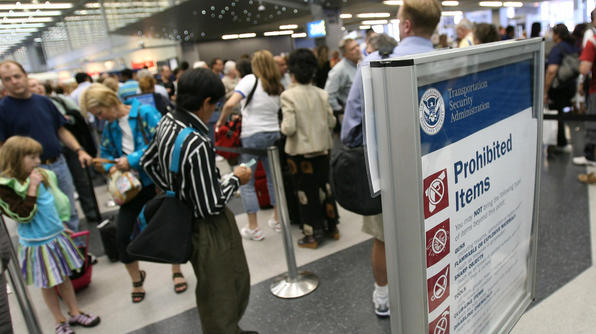
Remember the days when airport security lines were no problem? You could keep your clothes on, and keep your beverage? Remember when you could enter government building without being frisked?
One of the best ways to see your current situation in a new light is to imagine how different it would be if some key event had never happened. As we draw near to Christmas, I challenge you to think about what your life would be like if God had not sent his Son to our planet. Born in a manger. Born to Mary and Joseph. Born to die for us.
Do you see what I see? Clearly there would be no Christmas holiday. No gifts, no decorations, no carols, etc. But what else would be different? No Holy Night. No hope. No joy to the world. No purpose. No future.
As you reflect this season, take a moment to think how your life would be without Advent. What if it never happened? Then find a way to give thanks to the God who entered our world and took on human form. Thankfully it did happen. For me. For you. For unto us a child is born.
-Pastor Mark
25 easy ways to go retro in your faith

Let’s admit it…sometimes the modern conveniences and technologies that we love can rob us of the great experiences of previous generations. That’s why your grandma’s home-made brownies crush the store-bought competition every time, right?
There’s never been a time when books were more affordable and more numerous (electronic and otherwise). But it hasn’t always been this way. Before the invention of the printing press (props to Gutenberg!), books were very rare, and very expensive. Chances are, you wouldn’t have owned even one.
So how did followers of Jesus “read their Bibles” on a regular basis? Before the modern conveniences and technologies of the printing press, they were “old school.” In addition to hearing the Bible read (and seeing the stories in the artwork), they relied on memorizing. After all, if you memorize something, you don’t need to see it in a book, you can see it in your mind. (This works well for anyone who doesn’t particularly enjoy reading, too.)
Our Celebration Challenge this year includes an ambitious goal to memorize 25 verses. Think of it as 25 ways to read your Bible, retro style! Here’s a quick re-cap of the seven verses we’ve worked on so far. See how many you can remember.
- Ephesians 3:20 – Now to him who is able…
- Galatians 5:22-23 – But the fruit of the Spirit is…
- Matthew 5:16 – In the same way, let your light…
- John 3:16 – For God so loved the world…
- Philippians 4:6-7 – Do not be anxious about…
- John 13:34 – A new command I give you…
- Luke 12:15 – Then he said to them, “Watch out!… (this verse might help with your shopping list, too)
Take a few minutes this week to review. Look up the ones that you can’t quite remember. (Just click the link for the full verse.) Recite the ones you can. And savor the experience of a little old-school reading of the Word of God.
Then join us this weekend as we continue our series, “Coming Attractions.” What might Christmas hold for you this year?
-Pastor Mark
Why is everyone staring at you?

I love the scene from Elf (the movie) where Buddy’s dad walks past a department store display window in Manhattan only to discover his son is sleeping IN THE DISPLAY! The whole world is watching Buddy’s every move.
The truth is, window shopping is big business during the Christmas season. We’re checking out the trends, the merchandise, and the prices. The question just below the surface is always something like, “Do I want what they’re selling?”
Each time the church comes together, whether in small groups, large gatherings, or anything in between, we’re on display. And the world is window shopping. I was reminded of this by a recent blog post by Ed Stetzer.
The church is called to be both a sign and an instrument of the kingdom of God. It’s…God’s agent in the world showing and sharing the word of Jesus to a broken and hurting world. But it’s also a sign in the kingdom of God, a draw to the kingdom, a credible witness to the kingdom, etc., because people are supposed to look into the church and say, “That’s what the kingdom of God looks like.” In this sense, it’s a window into the kingdom that compels others to come be one in Christ with us.
Even as we shop at a window, we know there is much more inside. The fact of the matter is that Revelation chapter 7 says men and women will gather around the throne of God for eternity, and they will be from every tongue, tribe and nation.
Scripture goes to great lengths to point out the diversity around the throne. Thus, it seems only right and perhaps pleasing to God that our churches might be signs of the kingdom of God today in increasing multiculturalism. I am encouraged by the efforts I see, and challenged to move forward in my own life and church…
As our country continues to go through the Ferguson spasms, I’m reminded that the church is on display. How will we function as a new community, as a new family under the leadership and direction of Jesus Christ? Fittingly our current memory verse is in John 13:34:
A new command I give you: Love one another. As I have loved you, so you must love one another.
Everyone is staring at you (actually at all of us) to see. What will they see this week? Will they want what we’re “selling”?
-Pastor Mark
P.S. Join us this weekend for our new series, “Coming Attractions.” Can you feel the anticipation?
The war of Christmas
(The following is a guest post by John Sowalsky, whose script writing has benefited Seneca Creek in recent months. This post a bit longer than usual, but well worth your time. Plus, it’s Thanksgiving. You have a bit more time, right?)

We have once again entered into that season when our nation, and much of the world, is gearing up to celebrate Christmas, the least Christian of all Christian observances by a wide mile. Christians of many stripes are increasingly vocal, year after year, about a perceived “war on Christmas” which, supposedly, reflects an anti-Christian prejudice prevalent in the U.S. Thus, we see affirmations from Christian circles which can often be paraphrased as follows: “I’m going to wish you ‘a merry Christmas’ no matter who or how it offends, so suck it up, heathens!” Christmas, ostensibly a joyful celebration of the birth of the Prince of Peace, thus, becomes steeped in thinly-veiled hostility. Which does not seem particularly Christ-like to this writer. If Christ himself were offended by such a slight, whether actual or simply perceived, how would he be likely to respond? With love and humility, and without casting aspersions, implied or otherwise.
But there is an even more important issue to consider when we take up the subject of Christmas: Where did Christmas come from? Because the Bible says nothing — not one word — about commemorating the birth of Christ and, in fact, gives no solid information about when the date of his birth fell. The sad fact is that Christmas is an entirely manufactured, non-Biblical observance which has, in modern times, descended into a veritable orgy of crass consumerism mixed, even more recently, with faith-shaming.
My father’s parents, Jews who came to the U.S. in the early part of the 20th century, did not celebrate their birthdays. Indeed, they weren’t even certain about their dates of birth. This is because in Jewish tradition — the tradition from which Jesus emerged — the date of a person’s birth is not considered nearly as important as the date of their death. I can remember my father observing the Mourner’s Kaddish year after year in honor of his parents, yet when I pressed him on the subject of how old they were when they died, he could only offer a vague estimate. It can be argued that this attitude is reflected in the Bible in that the exact month and day of Jesus’ birth is never alluded to, although the timing of his death, relative to the Passover, is well-established. Whence, then, Christmas?
Although the observance of feasts celebrating the birth of Jesus can be traced back at least as far as 354 AD, there is no Biblical basis for such observances. It seems unlikely that the earliest churches would have recognized such a holiday, but this is conjecture. What is clear is that the traditional date of December 25th roughly coincides with a wide range of pre-Christian pagan practices largely centered around the winter solstice. The logic behind nascent Christianity subsuming various pagan observances is easy to grasp: it afforded newly-converted pagans something familiar to latch on to and, thus, helped to minimize their adjustment to their newly-adopted faith. It was, in short, good PR for the church and an effective marketing tool.
By the end of the Middle Ages, Christmas had been widely adopted throughout the Christian world. Some centuries later, however, in the wake of the Reformation, some Protestant groups (e.g., the Puritans) began to decry Christmas as an invention, dubiously founded upon pagan practices, of the Catholic Church. The celebration of Christmas here in “the Colonies” was spotty, enjoying great popularity in some regions, while being unequivocally forbidden in others. Thus, for example, Christmas was actually outlawed in Boston from 1659 to 1681.
Many of our modern-day Christmas traditions are relatively recent inventions. The concept of Christmas as a personal holiday (i.e., one celebrated with family and friends, as opposed to observed in community and church); the adoption of the Christmas tree as a symbol of the season; the exchanging of gifts (with the concomitant commercialization of the holiday); and many of the most beloved Christmas songs and carols, date back only as far as the 19th century. The contentious term itself — “Merry Christmas!” — seems to have been popularized no earlier than “A Christmas Carol” by Charles Dickens, a mere 171 years ago.
In even more recent times, Christmas has become at least partially secularized and has now become both the linchpin and barometer of the U.S. economy. The commercialization of Christmas has gone so far over the top that it is a regular subject of parody, and rightly so. In some circles, we are finally seeing a backlash to this trend, as more and more sincere Christians eschew the material trappings of the season. Instead of being “conformed to the things of this world,” they prefer to spend their time in service to others, and their financial resources in charitable giving.
Yet, still, with each passing year; as the marketing machinery grows increasingly manic; as the traditions become even further removed from their original intents; as gaudiness supplants solemnity; as the “haves” over-consume to the point of gluttony while the “have-nots” slowly waste away on the crumbs that fall from the table; still, we hear the outcry from the Christian left-right-and-center about a purported “war on Christmas.” But before we complain about Christ being taken out of Christmas, perhaps we should consider how he got there to begin with?
(To read more of John’s work, visit his site here.)
P.S. If you missed our Unleash Prayer event on Tuesday, take a few minutes to share your prayer of thanks right now. You may need to use a computer instead of a smart phone for this. And I, for one, am grateful for all who joined us in that expression of gratitude!
Magic words? Really?

What happens when you express your gratitude? Is there something magical about saying the words?
Well sort of. Because it’s easy for us to lose perspective. That problem you’re facing (with your spouse, your teen, your boss, your bills, your health, etc.) has a way of dominating your mind. It drowns out all the other aspects of life, and screams for your attention. It’s the squeaky wheel…and so you focus on it. And in the process, you lose perspective.
Expressing gratitude may not change the problem you’re facing. Your credit card debt won’t disappear because you stopped to say thank you. And your kids won’t magically behave. But expressing gratitude will change your perspective. You’ll realize that not everything is a problem. You’ll find room to squeeze a bit of joy into your challenging life. And it’s quite possible that your vision will be expanded to see the God behind the blessings in your life. Which can only lead to confidence, hope and more.
All of which is why Paul, the apostle in the early church, wrote these words:
Don’t be anxious about anything, but in every situation, by prayer and petition, with thanksgiving, present your requests to God. And the peace of God that transcends all understanding will guard your hearts and your minds in Christ Jesus. (Philippians 4:6-7, emphasis added)
In other words, gratitude expressed leads to real, powerful peace. That sound almost magical. But it’s true. Try it today. And while you’re at it, try to work on memorizing those two verses. They’re our current project in our Celebration Challenge for this year. I can tell you from personal experience they literally have the power to change your life.
Thanks for reading. Feel free to add your comments below.
Pastor Mark
P.S. Our Celebration Challenge prayer focus this month (on the 25th) will be a special web site to voice your own prayers of thanks. Watch for it on November 25th.
How much filth can one person view?

I recently read an article in Wired magazine about the little known world of content moderation. It’s a disturbing story of regular people who make their living by reviewing and moderating all the visual content that is uploaded to the internet. From your kid’s birthday party to grizzly beheadings to child molestation.
The article is the story of people who burn out after weeks or months of viewing the darkest, most depraved images imaginable. The human mind is simply incapable of processing all that garbage without suffering irreparable damage. They are overwhelmed by the filth and perversion of the human experiences. And it happens every single day.
Which got me thinking. Because I believe that God is aware of every aspect of our lives. He is aware of everything in his creation, including all the graphic images (uploaded and otherwise). And if ever there was evidence of the infinite grace of God, it’s his capacity to know, and to SEE all the dark, depraved events in our world (including, but not limited to those which are uploaded to the web), and yet STILL love the people he created. Despite how poorly the human race actually reflects the image of God at times, he still loves. He still longs to be in relationship with us. Let that soak into your mind for a minute.
In the words of the 19th century hymn,
O the deep, deep love of Jesus, vast, unmeasured, boundless, free!
Rolling as a mighty ocean in its fullness over me!
So while you may never see, or imagine some of the evil, dark desires and actions that content moderators see, you can take great encouragement that there is a God who sees all that, who absorbs all that horror and hatred, and who even sees everything in your life and your mind, and yet loves you as his long-lost child.
And for that we can be profoundly grateful today.
-Pastor Mark
 Living in faith, hope and Love